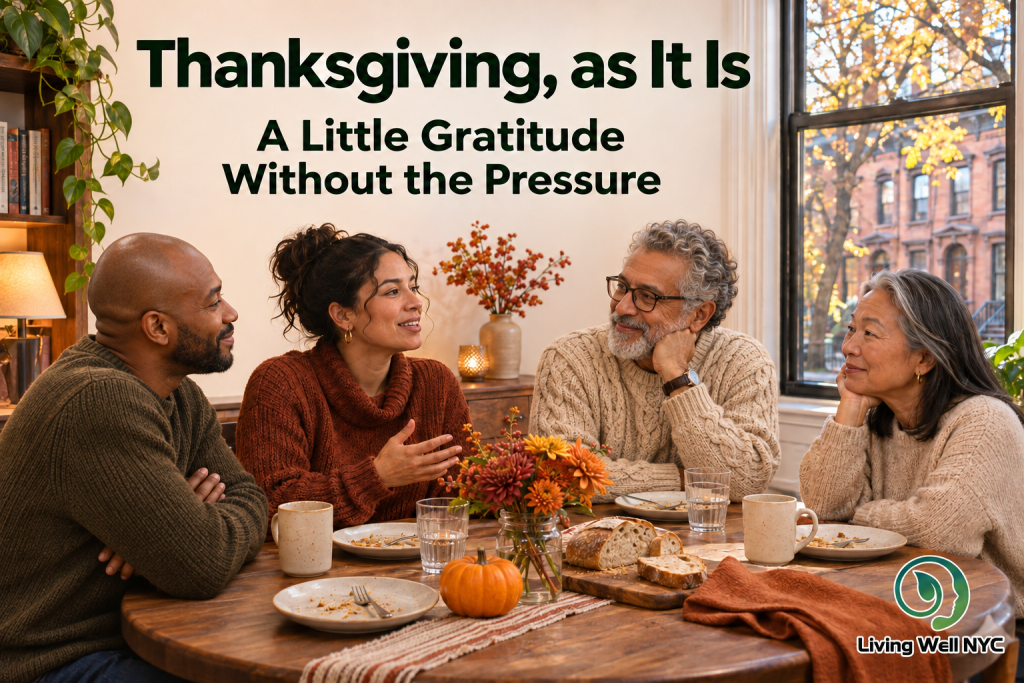
By the time Thanksgiving arrives, most of the arrangements have been made. Whatever is still unfinished will probably get done—or turn out not to matter very much. Eventually, people sit down, the food gets passed around, and the day becomes less about preparation and more about being together.
That can be the best part. Someone tells a story you’ve heard before, and you laugh anyway. A person you usually see only on a screen is sitting across from you. You finally have time to ask a question and hear the whole answer.
Other things come to the table, too. Worry about work. News you haven’t shared. The absence of someone who used to be there. These things don’t disappear because it’s a holiday, even when you’re enjoying yourself.
Thanksgiving asks us to pause and appreciate what we have. Sometimes that comes easily. Other years, it takes a little more thought to find words that feel true.
What being thankful can sound like
“What are you thankful for?”
It’s a familiar question, but the answer can be surprisingly difficult when the year has been complicated. You might have something to celebrate and something you’re still trying to get through. Saying only the good part can feel incomplete; explaining everything may be more than you want to do over dinner.
You don’t have to sum up the year.
Perhaps you’re thankful for a friend who kept inviting you out during a difficult stretch, even when you often said no. Or for someone who knew enough about your situation that you didn’t have to explain it from the beginning each time. Maybe a new job has been exhausting, but there’s a colleague who makes you glad to go in.
Those are specific things worth appreciating. They don’t require a conclusion about whether the year, overall, was good or bad.
Sometimes the most meaningful thank-you is also the least polished: “I don’t think I told you how much that helped.”
The person hearing it may remember the situation differently. What felt like a small favor to them might have made a difficult week manageable for you. Telling them gives you both a chance to recognize something that could otherwise go unmentioned.
There’s no need to wait for a turn at the table, either. You might say it while putting on your coat or send a message days later, once you’ve found the words.
Some of that appreciation can be for yourself. Think about something you managed this year that other people may know little about. Perhaps you asked for help after putting it off, or had a conversation you’d been dreading. You might still be in the middle of a difficult situation, with no clear ending in sight. It’s easy to overlook your own effort when there’s more to do. Give yourself a moment to acknowledge what it took to get this far.
And if gratitude feels difficult this year, forcing an answer probably won’t make it feel more sincere. You can listen to what others share and let your own thoughts take longer.
Being together without catching up on everything
Seeing family or old friends can bring an odd pressure to give a complete account of your life. There are questions about work, relationships, where you’re living, and what comes next. You may still be figuring out the answers yourself.
It’s possible to enjoy someone’s company without giving them a full update.
An ordinary conversation can be a welcome part of the holiday. Hearing about a cousin’s disastrous attempt at a recipe, asking what someone has been reading, or remembering an old neighborhood may be exactly the kind of company you wanted.
That matters when someone has been having a hard time. Concern can be kind, but being asked about the same difficulty by several people can become tiring. A guest may appreciate the chance to talk about something else for an afternoon.
If you’re unsure, ask privately whether they want to discuss it. Then follow their lead. They might have plenty to say, or they might want to hear what’s happening with you.
The same consideration applies to your own life. “I’m still working that out” can be a complete answer. You can leave something unfinished in conversation without pretending it doesn’t matter.
There may be a person at the gathering with whom things are strained. Sharing a meal won’t necessarily resolve that. Still, you might find a few comfortable minutes together, or discover that keeping some distance makes the afternoon easier. You don’t have to decide the future of the relationship before dessert.
The familiar things that feel different
Holidays make change noticeable. Children who once needed help with everything are carrying dishes to the table. Someone else is making a recipe that used to belong to one person. The gathering is smaller, or in a different home.
Sometimes these changes are welcome. Sometimes they hurt.
When someone has died, their absence can become especially clear in an ordinary moment. Nobody makes their usual comment. A dish tastes slightly different. A story reaches the point where they would have interrupted to correct a detail.
You may want to say their name or tell the story anyway. Someone else might be relieved that you did. But there’s no obligation to turn remembering into a group activity if that doesn’t feel right.
People can miss the same person in different ways. One may want to keep every tradition; another may find the familiar meal difficult to sit through. That difference can be hard to understand, particularly when you’re grieving yourself. It doesn’t necessarily mean one person cares more.
There are other absences, too: family far away, children spending the holiday elsewhere, a relationship that has ended. A good afternoon can still include moments when you wish things were different.
If you find yourself laughing, you haven’t forgotten anyone. If you need a quiet moment, you haven’t spoiled the day. Your feelings may change several times before the evening is over.
What stays with you afterward
Not every Thanksgiving involves a gathering. Some people are working, some are spending it alone, and some don’t observe the holiday. Even among those celebrating, the day can look very different from one household to the next.
That can be easy to forget when photographs start appearing online. A picture shows who stood together for a moment. It tells you very little about how anyone experienced the rest of the day.
Your own holiday may have been enjoyable, awkward, quiet, or a mixture you haven’t quite sorted out. You don’t need to give it a verdict as soon as it ends.
Afterward, perhaps one conversation will stay with you. You learned something about a relative you’d never thought to ask. Someone remembered a detail from your life that you assumed they had forgotten. You spent an hour with a friend and realized how long it had been since you’d done that without rushing.
Those moments are worth returning to. Send the photograph you promised. Ask for the recipe. Tell someone you enjoyed seeing them, and mean it.
There may also be something you’d rather do differently next year. You can acknowledge that without dismissing everything you enjoyed this time.
Thanksgiving gives us a reason to notice the people and experiences we value. What we notice may be modest, especially in a difficult year. A conversation felt easy. Someone was glad you came. For a while, you had time to sit together.
That’s something you can be thankful for without needing the rest of life to be settled.